
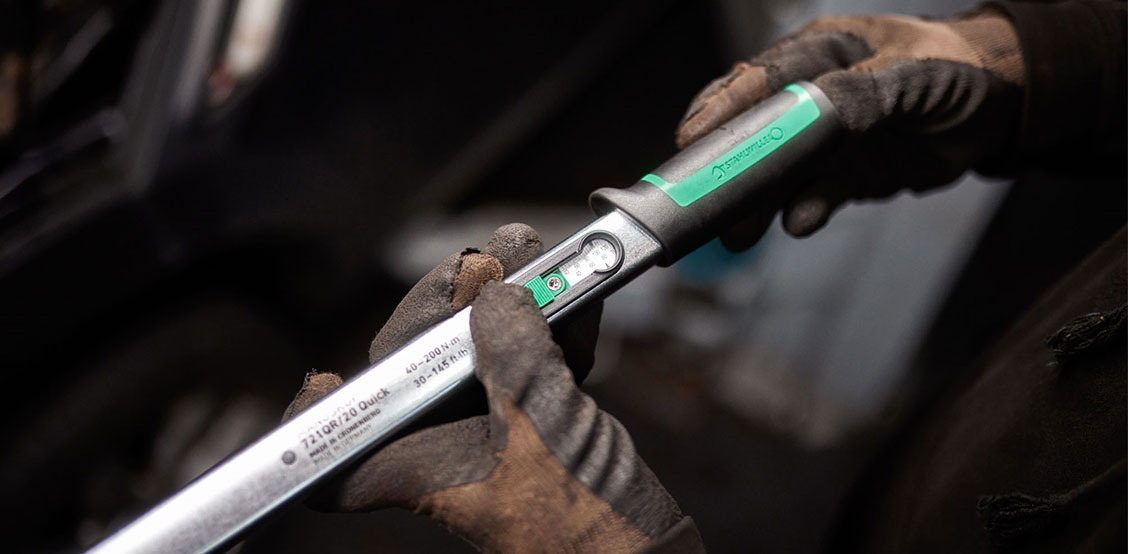
Set the torque, tighten the screw until the target torque is reached, wait for a “click” – done! Of course, it’s not as simple as in theory. Because even apparently small sources of error can affect the quality of your work. Here are the three most important ones!
01.
Parallax effect
Hold your index finger about 10 cm in front of your eyes and look at it with your left and right eye alternately. It seems as though the finger changes position. This is the parallax effect. The viewing angle is crucial for what we see. But what does this have to do with the torque wrench? Well, with most torque wrenches, the target torque is set using a rotary knob or a slider, and read off on a mark on a scale. If you look at the scale at an angle from the left or right rather than centrally from above, the relative position of the marking above the scale also changes! The parallax effect has occurred – and may cause you to set the wrong value. So always make sure you have the right viewing angle!
02.
Inside micrometer adjustment
Can you change the insert tool on your torque wrench? Then there is another source of error here! This is because each torque wrench is designed for a standard inside micrometer (SF), the so-called factory calibration measurement. If an inserting tool has a different inside micrometer, it will falsify the measurement results. In such cases, you must recalculate the torque value using a special formula. But don’t worry, it’s not rocket science! The inside micrometers are specified by the manufacturers and we have outlined how it all works here: What you need to know about the extension and the point of force application
03.
Reset to “0”
Inside most mechanical torque wrenches, there is a spring as a measuring element, which plays a crucial role in the triggering process. Simply put, the higher you set the target torque, the more you increase its tension. Like any component, the spring is naturally subject to a certain amount of wear. As it does not automatically “relax” after triggering, it is essential that it is reset to “0” at the end of the working day. Only then will the flexibility and tensile force be maintained over a long period of time and the precision of the wrench guaranteed.
It is worth noting that most STAHLWILLE torque wrenches do not work with a spring, but with the patented, practically wear-free bending rod principle. You don’t have to reset it to “0”! You can find more information here: The flexible rod system
Company
Service
2026© All Rights Reserved