
08.11.2025
External puller, internal puller, separation assemblies: What are they for?
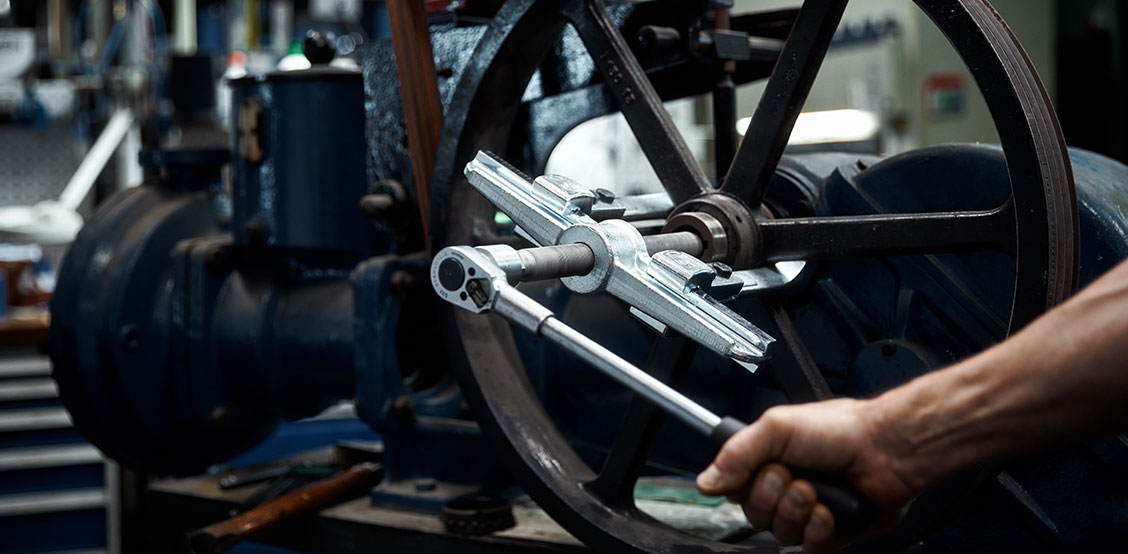
What is special about a puller? What is the special tool used for and which types are there? We will start with an overview of pullers and their applications.
01.
What is a puller?
Bearings, drive shafts, gears, pulleys, clutch and steering parts - they all have something in common: As a rule, so-called pullers are required for disassembly. Whether in the general mechanical field or in the maintenance of industrial machines and systems, in vehicle service, aviation or in the maintenance and repair of agricultural and construction machinery: Pullers are used wherever rotating components transfer their force.
02.
Why are pullers needed?
Components installed on a shaft are rarely detachable by hand, and in some cases they are within a housing and are difficult to access. For this reason, a suitable puller must be used for professional disassembly. The key advantages at a glance:
- Gentle disassembly: Pullers allow gentle and safe disassembly of components. In contrast to “improvised” methods, they enable an even distribution of the pulling force. This is important to prevent skewing, deformation or damage during the removal process.
- Control and reduce effort: The pulling procedure for external pulling does not take place by hand. Instead, a spanner is used to operate the puller’s spindle. The application is thus controlled. And the leverage effect of the spanner means that the amount of force required is comparatively low.
- Working in confined spaces or in housings: If there is little space available around the component to be removed or if it is difficult to access in a housing, pullers are specially designed to help to remove the component safely in these situations.
- Efficient working: Due to the fine thread of a spindle of the puller, high forces can be transmitted, which facilitates the pulling process. Pulling evenly prevents damage, which makes disassembly quick and efficient.
- Occupational health and safety: An accident protection tarpaulin must always be used when removing components - especially if they are rusted or seized. The puller may come loose suddenly if high force is applied, e.g. due to rust or strong material bonds. There is a risk that a pulling jaw may come loose from the side or jump off in an uncontrolled manner. This may result in injury.
03.
What are the possible applications?
There are three main areas of application for which a specific puller solution is available.
Scenario 1: The part to be removed is mounted on a shaft.
A puller is used here, which inserts under the relevant part at several points. A pulling force is exerted simultaneously on the component and a compression force on the shaft - the component moves upwards - via the previously mentioned spindle.
Scenario 2: The part to be removed is located in a trough or recess.
For such cases, there is the so-called internal puller. This grips the part to be removed from the internal side and a choice is made as to whether a counter stay or a slide hammer is attached. If there isn't a suitable place for counter stay arms to be positioned then a slide hammer is used. If a counter stay is inserted, pulling and compression forces build up, which set the part to be removed in motion, as with the external puller.
Scenario 3: The part to be removed is flat or flush on a surface.
If the hooks of a conventional external puller cannot be located under the component, the handle is attached to the separation assembly. The principle is simple: First, semi-circular tapering jaws slide under the component from two sides in a controlled manner and lift it slightly. These “separators” are then lifted by turning an additional spindle device, moving the component upwards using the principle of external pulling.
You are now familiar with the three main use scenarios. We will now explain the puller solutions that are suitable for this:
Would you like to get to know the puller range from STAHLWILLE? Click here to see our products:
Company
Service
2026© All Rights Reserved