
20.04.2026
How STAHLWILLE tools support the maintenance of wind turbines in the North Sea
Inhalt
C-Power’s offshore wind farm in the Belgian North Sea supplies sustainable energy to 300,000 households. It’s the only wind farm in Belgium in which the operator sends its own service technicians to the platforms. And they always take tools for wind turbines from STAHLWILLE.
01.
Thornton Bank offshore wind farm: power for 300,000 households
54 wind turbines delivering up to 326 megawatts per year to the Belgian power grid. Spread over an area of around 20 square kilometres, 30 kilometres from the coast. That’s the Thornton Bank wind farm, which is operated and maintained by the Zwijndrecht-based company C-Power NV. Safety and efficiency take top priority, which is why the company runs a training centre in Ostend where it runs realistic simulations and training courses for the inspection and maintenance of wind turbines.
02.
Tools for offshore wind turbines
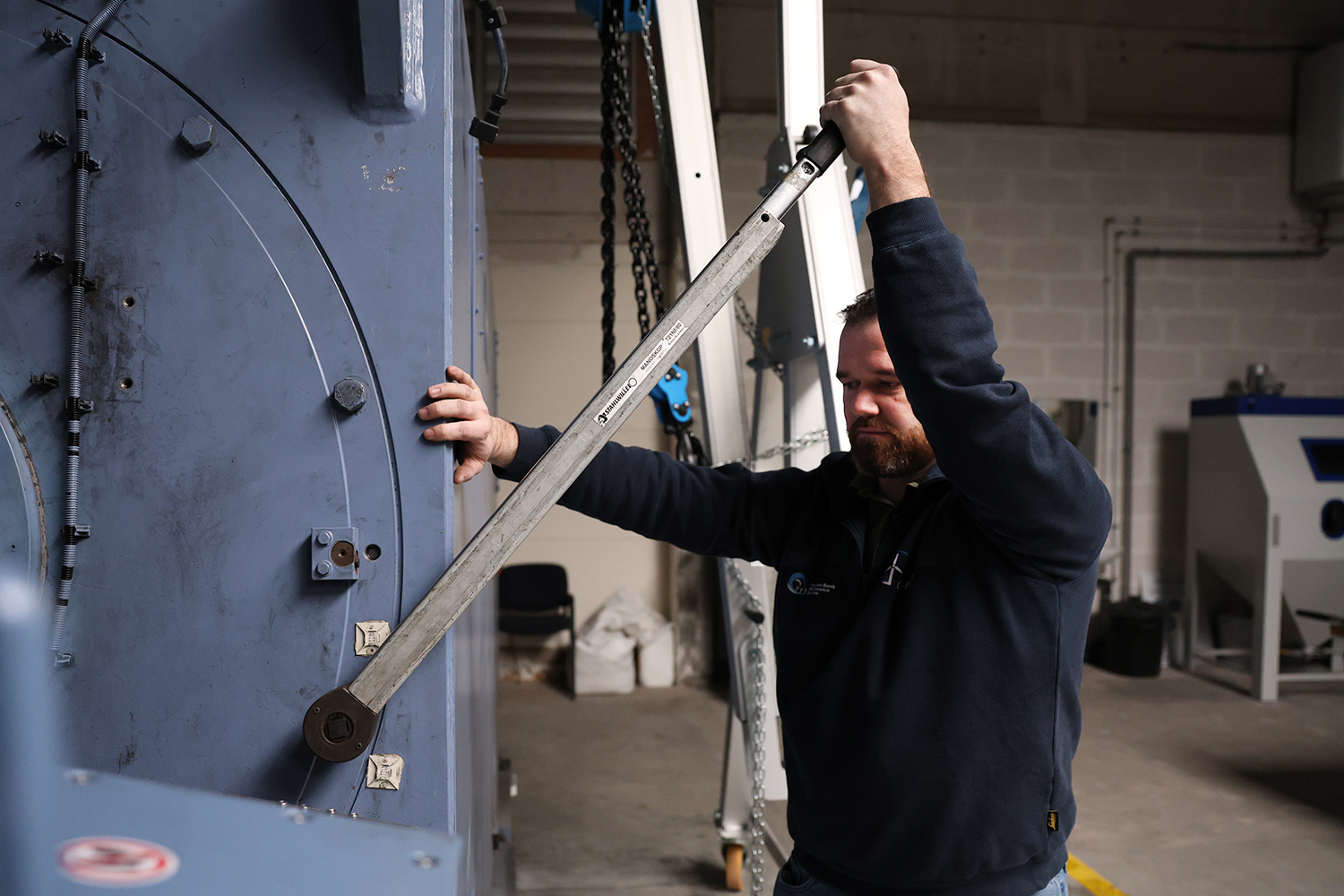
Offshore wind turbines require regular maintenance to keep mechanical and electrical components working reliably and prevent outages. Tools from STAHLWILLE are ubiquitous in Ostend, accompanying technicians on every flight to the platforms. Their equipment includes around 100 mechanical torque wrenches, such as the MANOSKOP® 721Nf/80, MANOSKOP® 730N, and MANOSKOP® 730 Quick. C-Power also owns customised tool sets with insert and shell tools, ratchets, spanners and much more.
There were several reasons why we chose STAHLWILLE. Firstly there was the robustness and reliability of the torque wrenches. Then there was the precision with which they achieve bolted joints, from 20 N·m to 800 N·m. And finally, it’s crucial to prevent turbines worth half a million euros each from being damaged due to a loose bolt.
Stijn Lefevre, Asset Engineer at C-Power
03.
Efficient maintenance of offshore wind turbines
And there were other factors in STAHLWILLE’s favour too. The fact that the torque wrenches don’t need to be reset to 0 saves precious time, says Lefevre. Obviously, every minute a wind turbine is out of action is a minute when it isn’t producing any electricity. When choosing a tool partner, he and his colleagues also took every gram of weight into account, because the transport capacity of the helicopter is limited. They found that STAHLWILLE torque wrenches are lighter than those of most other brands, making them ideal for platform hopping.
Finally, there was the QuickRelease feature and Tool Control System, which virtually eliminate the risk of unintended tool loss. Lefevre says: “We've optimised the tool sets for transport by helicopter. They only contain the tools we need for the job. QuickRelease makes tool changes quick and safe. And with the TCS foam inlays, the technician can see immediately if a tool is missing before takeoff.”
It’s a case of clean energy made possible by clean working. With a little help from STAHLWILLE.
Thornton Bank wind farm – Facts
Location: Belgian North Sea, 30 km offshore | Area: Approx. 20 km² | Turbines: 54 | Output: 326 MW | Households supplied: 300,000
On a wind turbine, many bolted joints are safety-critical. The wrong torque can result in material fatigue, component damage, or turbine failure. Precision torque wrenches help to achieve defined values reliably.
Company
Service
2026© All Rights Reserved